Archived Winner Data Reveals Trends in Frequent Contest Participants Across Prize Types
Henrik Schröder · Aug 26, 2026

Archived Winner Data Reveals Trends in Frequent Contest Participants Across Prize Types
Archived winner announcements from major contest platforms and sponsor sites provide a rich dataset for examining repeat participants, and analysts have compiled records spanning multiple years to identify consistent entry patterns. These records include names, locations, and prize details that surface repeatedly in categories such as cash awards, travel packages, and household goods. Data compiled through August 2026 shows that certain individuals appear in winner lists at rates three to five times higher than average entrants across similar time frames.
Methods Used to Extract Patterns from Public Records
Researchers gather information by scraping publicly posted winner announcements on brand websites, retailer portals, and promotional archives, then cross-reference names and locations while removing duplicates through standardized matching protocols. Government agencies in several regions publish guidelines on contest transparency that encourage retention of these records for audit purposes, and one such resource comes from the Australian Competition and Consumer Commission which outlines disclosure requirements for promotional activities. Analysts apply frequency counts to determine how often the same entrants claim prizes in high-volume categories versus lower-volume ones, revealing that cash prizes generate the highest repeat rates while experiential travel awards show more dispersed winner pools.
Category-Specific Trends in Repeat Participation
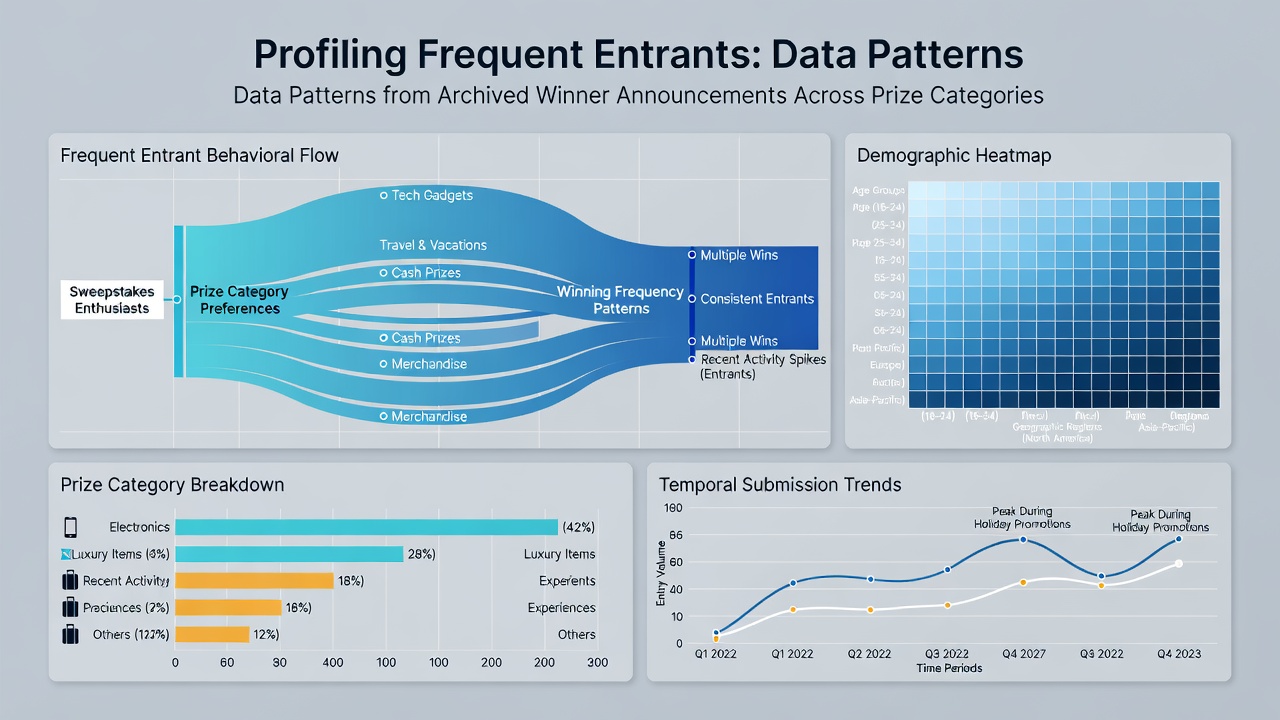
Cash prize announcements display clusters of repeat winners in the $500 to $5,000 range, with some participants securing multiple awards within a single calendar year. Travel-related categories produce fewer repeats overall, yet a subset of entrants surfaces across different trip types, suggesting targeted strategies around airline and hotel partner promotions. Household and electronics prizes demonstrate moderate repeat patterns concentrated in seasonal campaigns, where archived data from spring and fall periods indicate higher claim volumes from the same geographic clusters.
Automotive and home-related categories yield the lowest repeat rates according to aggregated records, although observers note occasional overlaps when sponsors run multi-brand tie-ins. Figures from these archives indicate that participants who win in one category often shift focus to adjacent categories in subsequent months, creating observable migration paths through the data.
Geographic and Temporal Distributions
Winner lists sorted by state and province show elevated repeat activity in regions with higher population density, yet rural entrants appear at comparable per-capita rates in cash and merchandise categories. Temporal analysis of announcements from 2023 through August 2026 highlights spikes in repeat claims during summer months for travel prizes and during holiday periods for retail goods. These patterns align with sponsor promotion calendars rather than random distribution, and cross-category comparisons confirm that entrants who succeed in one season often reappear in similar time slots the following year.
Demographic Indicators from Announcement Metadata
Although announcements rarely list age or occupation, location data combined with prize type allows indirect profiling. Urban postal codes correlate with higher repeat rates in electronics and cash categories, whereas suburban and small-town codes appear more frequently in home improvement and vehicle prize announcements. Researchers have cross-checked these observations against public census aggregates to identify alignment between repeat winner density and areas with strong broadband access, which facilitates daily entry routines.
Implications for Contest Organizers and Data Analysts
Contest sponsors reviewing these archived patterns gain insight into entry volume concentration, and several industry reports from European trade associations document similar findings across member countries. One such overview appears through the European Gaming and Betting Association which tracks promotional compliance metrics including winner diversity. Organizers adjust prize structures and eligibility rules based on these trends to broaden participation, while analysts continue refining matching algorithms to account for name variations and address changes that appear in successive announcement cycles.
Conclusion
Archived winner announcements across prize categories continue to supply measurable indicators of frequent entrant behavior, and systematic review of these records through August 2026 has clarified category-specific frequencies, geographic concentrations, and temporal alignments. The resulting profiles support more precise tracking of participation dynamics without reliance on individual survey responses.